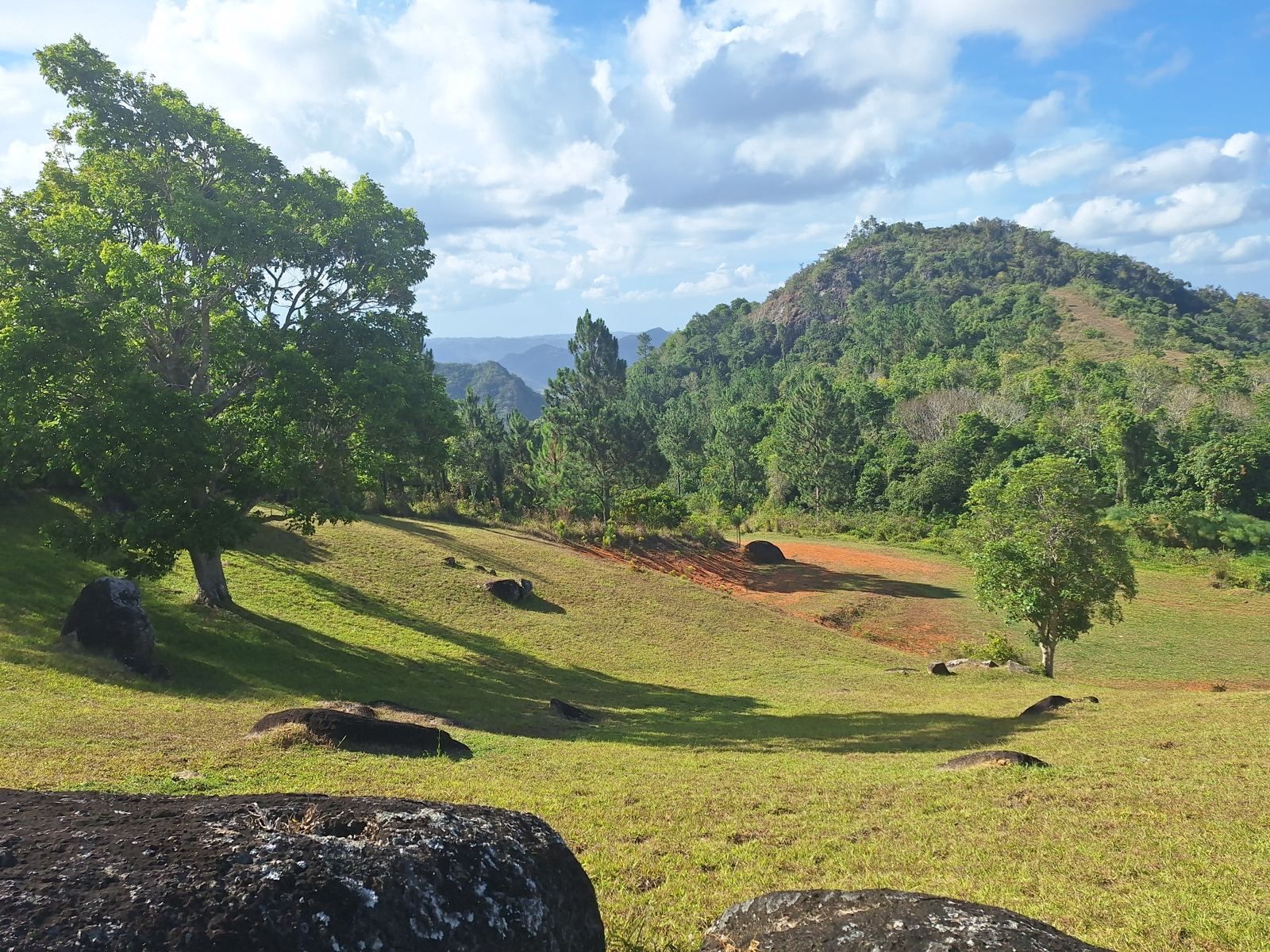
Searching for a farm, a finca or a private mountain estate in Puerto Rico is nothing like searching for a condo in Condado. Listings are scattered across a dozen portals, half of them in Spanish, land is measured in a unit most mainland buyers have never heard of, and the questions that actually decide whether a property works for you, about zoning, water, taxes and how the deal gets financed, are rarely answered on the listing itself. This guide answers them in one place.
Where farms and estates are listed, and why there are so few
Puerto Rico has roughly 3.2 million people on an island of about 3,500 square miles, and most of the flat land near the coast was built on or farmed out decades ago. Large private holdings in the interior do exist, but they change hands rarely and often privately. When one does come to market it may appear on the Stellar MLS feed that powers Zillow, Realtor.com and homes.com, on a local portal such as FindItPR or Clasificados Online, on land-specific sites like LandBrokerMLS, or only on a hand-painted sign at the gate.
Two habits make the search easier. First, search in both languages. The Spanish terms are finca (a farm or rural holding), terreno (land) and cuerdas (the unit of area). A listing described as "finca de 100 cuerdas en Cayey" will not surface for "100 acre farm Cayey". Second, expect listings to be thin. A typical rural listing gives a price, a cuerda count and a few photos. Everything else, from zoning to the water source, is on you to confirm, which is what the rest of this guide is for.
What a cuerda is, and how it compares to an acre
The cuerda is the traditional Spanish land unit still used in Puerto Rican deeds, the Property Registry, CRIM tax records and most local listings. One cuerda equals about 3,930 square meters, which is 0.971 acre. The two units are so close that mainlanders sometimes call the cuerda a "Spanish acre" and many people round them as equal, but on a large parcel the 3 percent difference matters:
- 50 cuerdas is about 48.6 acres
- 100 cuerdas is about 97.1 acres
- 100 acres is about 103 cuerdas
- 1 hectare is about 2.54 cuerdas, or 2.47 acres
When you compare price per unit across listings, make sure you know which unit the seller is quoting. A price "per cuerda" is slightly higher per acre than it looks. And when a mainland portal shows acres, it has usually converted from the cuerda figure in the deed, sometimes correctly and sometimes not; some aggregator sites label square meters as acres, which is how a finca of about 5 cuerdas (20,791 square meters) ends up advertised as "20,791 acres". Trust the deed. For worked conversions, see Cuerdas, hectares and acres.
What A-G, A-P, R-G and B-Q zoning mean
Land use in Puerto Rico is governed island-wide by the Puerto Rico Planning Board (Junta de Planificación) through the Reglamento Conjunto and each municipality's land use plan, rather than by county codes as on the mainland. Every parcel carries a calificación, a zoning district code. The ones you will see most often on rural listings are:
- A-G, Agrícola General. General agricultural land. Farming, grazing, forestry and the homes and outbuildings that support them are the intended uses. It is the most common classification on mountain fincas.
- A-P, Agrícola Productivo. Productive agricultural land, usually the better soils and the designated agricultural reserves. Protection is stricter, and in some reserves the law only allows subdivision into parcels of 50 cuerdas or more.
- R-G, Rural General. A mixed rural district that often permits agro-tourism, lodging and similar income uses alongside farming and residences.
- B-Q and other conservation or special districts. Some parcels carry a second classification on part of the land. On the Cayey estate described below, for example, the A-G land is paired with a B-Q district that permits eco-tourism and related uses.
- SRC, Suelo Rústico Común, and SREP, Suelo Rústico Especialmente Protegido, are the broader soil classifications from the municipal plan that sit above the district code. SREP land has environmental or agricultural protections that limit development.
What the codes allow in practice depends on the current regulation and on whether a use is permitted outright, permitted with conditions, or requires a consulta de ubicación (location consultation) from the Planning Board or the municipality. Before you buy for a specific purpose, whether that is a wellness retreat, an equestrian operation, short-term rental cabins or simply a second home, pull the parcel's calificación from the Planning Board's map, read the permitted-use table for that district, and if the use is not listed as of right, price in the time and cost of the consultation. A buyer's attorney or a licensed planner can do this in a few days.
How much farmland and acreage cost in Puerto Rico
There is no single market. Asking prices in late 2026 range from under $10,000 per acre for large tracts of raw mountain land without utilities to several hundred thousand dollars per acre for small lots near the coast or next to an expressway. A few reference points from current and recent Cayey-area listings:
- Large raw parcels of 100 to 150 acres in the Cayey mountains have been offered at roughly $8,000 to $20,000 per acre, with price depending heavily on road access, slope and whether water and power reach the land.
- Parcels of 30 to 40 acres with expressway access have asked $15,000 to $37,000 per acre.
- Small residential lots of a quarter acre to two acres inside or near town run $75,000 to $320,000 per acre, because they are priced as home sites, not farmland.
- Improved estates, meaning acreage with a finished residence and infrastructure, trade on the whole package rather than per acre. In 2026, mountain estates with a house and anywhere from 5 to 100 acres have been listed between $1,500,000 and $4,000,000 across Cayey, Adjuntas and Utuado.
The practical lesson: raw land looks cheap until you add a well, a cistern, a drive, power, fencing and a house, each of which costs more in the mountains than on the coast. An estate that already has those things is often the better value per usable acre, even at a higher headline price.
Why buyers choose the central mountains over the coast
Cayey, Aibonito, Cidra, Barranquitas and the surrounding municipalities sit in the Sierra de Cayey and the Cordillera Central, the mountain spine that runs the length of the island. Cayey's town center is around 1,300 to 1,500 feet above sea level, and the ridges above it rise past 2,000 feet; Aibonito's plaza, at 2,401 feet, is the highest in Puerto Rico. The altitude changes the climate. Average highs in Cayey town are in the high 70s to low 80s Fahrenheit year round, winter nights drop into the 50s and low 60s, and higher properties run cooler still, typically 10 to 20 degrees below San Juan on the same afternoon. Mornings bring the mist that gives Cayey its nickname, "la Ciudad de las Brumas".
The other reason is access. From Cayey the Luis A. Ferré expressway (PR-52) reaches San Juan and the international airport in about an hour, which is close enough for a weekly commute and far enough to feel removed. The town has supermarkets, a Mennonite hospital, a University of Puerto Rico campus and the lechoneras of Guavate, and the Jájome and Cercadillo areas have long been where San Juan families keep weekend homes; the governor's official summer residence is in Jájome Alto. Mountain land also sits above the coastal flood and storm-surge zones, which has become part of the calculation for many buyers since Hurricane María.
Water, power and internet: what to verify
Infrastructure is where rural Puerto Rico purchases most often go wrong, so confirm each item in writing rather than from the listing.
- Municipal water. The Puerto Rico Aqueduct and Sewer Authority (AAA) serves many rural roads, but not all, and pressure can be intermittent at elevation. Ask for the account number and a recent bill.
- Wells and water rights. A drilled well is valuable, and the depth, yield and pump condition should be documented. Extracting water from a well, a creek or a spring for anything beyond basic domestic use generally requires a water franchise (franquicia de agua) from the Department of Natural and Environmental Resources (DRNA). Ask whether one exists and what it covers.
- Storage. Cisterns are standard on well-run properties. A 12,000-gallon cistern, for example, carries a household and animals through the water interruptions that follow a major storm.
- Power. Grid electricity is supplied by LUMA Energy. Confirm the meter and service size, and look for a generator transfer switch or an installed generator. South- and east-facing slopes at elevation are good candidates for solar and wind, and many mountain homes now run hybrid systems.
- Internet. Fiber is rare on mountain roads. Starlink has largely solved this, and it is worth confirming that the dish has a clear view of the sky from where you would put an office.
- Access. Make sure the drive from the public road to the house is on the parcel or covered by a recorded easement (servidumbre de paso), and drive it yourself after rain.
Property taxes, CRIM and the bona fide farmer exemption
Real property tax in Puerto Rico is assessed and collected by CRIM (Centro de Recaudación de Ingresos Municipales), not by the municipality directly. Assessed values are based on decades-old valuation tables and are typically a small fraction of market value, so annual bills on rural land are modest by mainland standards. The 100-acre estate described below, with a remodeled residence, pays about $990 per year. Always ask for the CRIM account and confirm there are no unpaid balances, because they follow the property.
If you intend to operate the land as a farm, the Puerto Rico Incentives Code (Act 60-2019, Chapter 8, as amended by Act 67-2025) offers a separate set of benefits to agricultores bona fide. A bona fide farmer certification is issued by the Puerto Rico Department of Agriculture, is valid for four years, and generally requires that the agricultural business be the applicant's principal activity by income. Certified farmers are exempt from property tax on land and improvements used in the agricultural business, exempt from municipal license tax and from sales and excise tax on farm inputs, and pay income tax on only 10 percent of net agricultural income. The rules on how much of the property must be in agricultural use and how income is measured have been clarified more than once, so have a Puerto Rico CPA confirm the current thresholds before you build a plan around them.
Act 60 and a rural estate
Many buyers of mountain estates in the last few years have been Individual Resident Investor decree holders under Act 60 (the successor to Act 22). The decree requires, among other things, that the holder become a bona fide resident of Puerto Rico and purchase residential property on the island within two years. A rural estate with a residence is residential property, and a number of decree holders have chosen exactly this kind of property for the privacy and the climate.
Two cautions. First, the program changed in 2026: Act 38-2026 altered the terms for new applicants, including the rate on qualifying investment income, while leaving existing decrees in place, so the economics differ depending on when a decree was granted. Second, the IRS has an active compliance campaign on Act 22 and Act 60 residency, and a second home used mostly on weekends will not establish bona fide residency on its own. If Act 60 is part of your reason for buying, retain a Puerto Rico tax attorney before you sign a purchase contract, not after.
How the purchase works: title, surveys and closing
Puerto Rico follows a civil-law property system. Title is evidenced by a public deed (escritura) executed before a Puerto Rico notary, who in Puerto Rico is always an attorney, and recorded in the Property Registry (Registro de la Propiedad) for the section where the land lies. A standard due diligence file for rural land includes:
- A certified Registry study showing the current owner, the recorded area in cuerdas, easements and any liens or mortgages.
- A recent survey (mensura) by a licensed agrimensor, reconciled against the Registry area. On older fincas the deed, the CRIM record and the fence lines may all disagree, and the survey is what settles it.
- The Planning Board calificación and, if you plan a non-agricultural use, an opinion on what approvals it would need.
- FEMA flood zone, and for coastal land a maritime-terrestrial boundary (deslinde); mountain land is rarely affected.
- CRIM tax certification and utility account status.
- Confirmation that any segregation of parcels, if the land is sold in pieces, has been approved and recorded.
Closings are handled by the notary, who collects the deed stamps and recording fees and files the deed. Title insurance is available from US underwriters and is commonly used by mainland buyers. Buyer's agents are routinely paid from the listing commission, as on the mainland, so bringing your own agent usually costs you nothing.
Owner financing and lease with option to buy
Local banks will finance a primary residence on a modest lot, but they are conservative about raw land, large acreage and anything that looks like a farm, and mainland lenders rarely lend in Puerto Rico at all. That is why so many rural transactions are cash, and why two seller-assisted structures are common:
Owner financing. The seller takes back a mortgage for part of the price. Terms are negotiated like any loan: down payment, rate, amortization and a balloon date by which the buyer refinances or pays off. The mortgage is recorded against the property and foreclosed through the courts if unpaid, so sellers usually want a meaningful down payment and proof of funds.
Lease with option to buy (arrendamiento con opción a compra). The buyer leases the property for a fixed term, typically one to three years, pays a non-refundable option fee at signing, and holds the right, but not the obligation, to buy at a price fixed in the agreement. A portion of each month's rent is often credited toward the purchase price if the option is exercised. This structure suits buyers who are relocating, waiting on the sale of a mainland home, or establishing residency for a tax decree, because they can live on and operate the land immediately. For sellers it produces income during the term and a tenant who has already committed capital. A well-drafted agreement spells out who maintains what, whether improvements are permitted, and what happens to the option fee and rent credits if the buyer walks away. Note that a lease purchase, which obligates the buyer to close, is a different instrument; make sure the contract says which one you are signing.
A worked example: 100 acres in Cayey
To make the above concrete, here is how the checklist applies to the estate this site describes, a gated 100-acre property (about 103 cuerdas in two fee-simple parcels) at roughly 2,100 feet on PR-7722 in Cayey, near the Aibonito line:
- Zoning: A-G agricultural with a B-Q district, allowing farm, ranch, residential, eco-tourism, equestrian and veterinary uses. The land previously ran horses, cattle and chickens and grew produce for San Juan restaurants.
- Water: municipal AAA service, a 550-foot drilled well, a 12,000-gallon cistern and two year-round creeks.
- Power and connectivity: LUMA grid service, a generator hookup, Starlink internet and remotely monitored cameras and alarm.
- Improvements: a three-bedroom, two-bath main house built in 1976 and remodeled in 2026, offered furnished; a second residence for renovation; a gatehouse, perimeter fencing, corral, trails and a summit lookout.
- Taxes: about $990 per year through CRIM, no HOA.
- Terms: for sale at $2,375,000, reduced from $2,500,000; for long-term furnished lease at $15,000 per month; or a lease with option to buy on negotiated terms. Owner financing is available. Buyer's agents are protected, and the property is on Stellar MLS as PR9124119.
At the asking price that works out to about $23,750 per acre with the residence, infrastructure and furnishings included, which is the comparison worth making against raw-land listings that will need all of those things added. You can see the photographs, the location and the full details on the main page, and schedule a private visit from there.
Frequently asked questions
How big is a cuerda compared to an acre?
Can a US citizen from the mainland buy a farm in Puerto Rico?
What does A-G zoning mean in Puerto Rico?
How much is property tax on a farm in Puerto Rico?
Does a farm or mountain estate satisfy the Act 60 home-purchase requirement?
How does a lease with option to buy work on a Puerto Rico property?
What should I check before buying land in Puerto Rico?
Sources and further reading
- Cuerda and Puerto Rican units of measurement, Wikipedia, for the cuerda conversion and its status as an official unit.
- Act 67-2025, amending Chapter 8 of the Puerto Rico Incentives Code on bona fide farmer certification and exemptions (Office of Management and Budget, Government of Puerto Rico).
- Act 51-2021, setting the four-year validity of the bona fide farmer certification.
- Cayey climate averages, US Climate Data.
- Puerto Rico tax incentives under Act 60: the 2026 guide, Taxes for Expats.
This article is general information for prospective buyers, not legal, tax or investment advice. Puerto Rico's zoning regulations, incentive laws and tax rules change; verify current requirements with a licensed Puerto Rico attorney, CPA and surveyor before purchasing. Figures for the Cayey estate are provided by the owner and should be independently verified.