In Puerto Rico, what you are buying is defined by two documents that frequently disagree: the entry in the Property Registry, which says who owns a finca and what it supposedly measures, and the survey, which says what is actually on the ground. Rural land is where they disagree most. This guide explains how the Registry works, how to read the title study your attorney will order, what the common encumbrances mean, why the cuerdas on the deed rarely match the cuerdas inside the fence, and how those gaps get closed before you close.
How the Property Registry works
Puerto Rico's Registro de la Propiedad dates to 1893 and the Spanish mortgage law, and it still follows the civil-law model rather than the deed-recording system familiar on the mainland. The governing statute today is Act 210-2015, the Property Registry Act, and the Registry is part of the Department of Justice. The key difference from a US county recorder is that the Registry does not simply file whatever is presented. A registrar (registrador) examines each document for legal sufficiency before recording it, and a recorded right enjoys strong legal presumptions in favor of the person who appears as its holder.
Since 2016 the Registry has been fully digital. The platform, called Karibe, holds more than 11 million digitized folios and tens of thousands of historical volumes going back to the nineteenth century, and it connects in real time with CRIM, the permits office and the Treasury. Notaries file deeds electronically, and title examiners search it online. That does not make the old entries any more precise than they were when a clerk wrote them by hand; it makes them easier to find.
Fincas, finca numbers and registry sections
The unit of the Registry is the finca, a recorded property with its own number and its own history of entries (asientos). A single estate may be one finca or several: a farm that grew over decades by purchase from neighbors is often a collection of separately recorded fincas that happen to share a fence. Each finca belongs to one of the Registry's 29 sections, which are organized by region. According to the Department of Justice's demarcation list, for example, Cayey properties are recorded in the Caguas I section, Cidra in Caguas II and Aibonito in Barranquitas. When you see a reference like "finca number 12,345, recorded at folio and volume of Cayey, Registry of Caguas, First Section", that is the address of the property's legal history.
The finca number is not the same thing as the cadastral number (número de catastro) on the CRIM property tax record. One identifies the property in the Registry; the other identifies it for tax purposes. A good title study ties the two together, and when they do not line up it is the first sign that something needs attention.
Reading a title study, line by line
A title study (estudio de título) is a report prepared from the Registry by a title examiner or title company and reviewed by the notary who will close. It is typically a few pages and covers, in some order:
- Identification. Finca number, municipality, registry section, and the volume and folio or digital reference.
- Description. The recorded description, word for word: the barrio, the boundaries (colindancias) by direction, and the area, today in square meters and often also in cuerdas. On older rural fincas the boundaries may read "north, lands of the heirs of so-and-so; south, a public road", which is why surveys matter.
- Ownership. The current recorded owner, how they acquired title (purchase, inheritance, donation), the deed number, notary and date, and whether the property is community property of a marriage.
- Encumbrances (cargas y gravámenes). Every recorded burden, in order of recording: mortgages, liens, attachments, easements, use restrictions, leases and options.
- Pending documents. Deeds or orders presented to the Registry but not yet recorded (documentos pendientes). These can change the picture and must be followed up.
- Origin and segregations. Whether the finca was segregated from a larger parent finca or formed by joining others, with references to those entries.
Read it alongside the CRIM record and the survey. The questions to answer are simple: is the seller the recorded owner, are all the owners signing (including a spouse or every heir), what has to be cancelled at closing, and does the land described match the land you walked?
Liens, mortgages, easements and other burdens
- Mortgages (hipotecas). Recorded mortgages stay on the finca until a cancellation deed is recorded. A paid-off mortgage that was never formally cancelled is common on older properties and is fixed at closing with a cancellation deed from the lender.
- Tax liens. Federal tax liens and Puerto Rico Treasury liens can be recorded against the owner's property. Unpaid CRIM property taxes are a statutory lien that follows the property even when not shown in the Registry, which is why the notary also requires a CRIM debt certification.
- Attachments and lis pendens (embargos, avisos de demanda). A sign that the property is the subject of litigation. These must be resolved or cancelled before closing.
- Easements (servidumbres). Rights of way, utility easements for power lines and water mains, and drainage easements. On rural land the critical one is often the right of way that gets you from the public road to the house, which should be recorded if the drive crosses a neighbor's land.
- Restrictions. Use restrictions, conservation easements or conditions from a government land program. Some agricultural lands sold by the Land Authority, for example, carry restrictions that survive later sales.
- Leases and options. A recorded lease or option binds a buyer. That is useful if you are the tenant, and something to clear if you are not.
Segregations and agrupaciones
Dividing a finca into new fincas is a segregación; combining fincas into one is an agrupación. Both require a survey plan by a licensed surveyor (agrimensor) and, for a segregation, approval from the Permits Management Office (OGPe) or the autonomous municipality under the zoning rules, before the Registry will record the new fincas. A seller who says land "can be subdivided" is describing a possibility; a recorded segregation is a fact. If a listing includes parcels that were divided informally, by a fence and a handshake but never by approved segregation, the buyer inherits the job of making them legal.
Why the survey disagrees with the deed
The Registry records the area stated in the documents presented to it. Historically it did not send anyone to measure. So the recorded area of an old rural finca is whatever an owner, a notary or a neighbor estimated decades or a century ago, often in cuerdas, often rounded, and often carried forward unchanged through every sale since. Boundaries were described by reference to neighbors, roads, streams and trees that may no longer exist. Meanwhile fences moved, roads were widened, and pieces were sold off without the paperwork catching up.
When a licensed surveyor measures the property today with modern equipment, the result is the area inside the actual boundaries, and it routinely differs from the recorded figure. A difference of a few percent is normal on mountain land. Differences of 10 or 20 percent are not rare. The CRIM record may show a third number. None of this is necessarily a problem, but it has to be understood before closing, because the price, the zoning analysis and any future segregation all depend on which number is right.
The practical rule: on rural land, order a current survey (mensura) from a licensed agrimensor, have it tied to the recorded boundaries, and have your attorney compare it with the Registry and CRIM figures. For the unit conversions involved, see cuerdas, hectares and acres.
Rectifying the recorded area
When the survey shows that the recorded area of a registered finca is wrong, the owner can correct it through a rectification of area (rectificación de cabida). Under Act 210-2015 this requires, among other things, a sworn certification from a licensed surveyor, and depending on the size of the change it may proceed by notarial document or require a court proceeding with notice to the neighbors. The Puerto Rico Supreme Court confirmed in 2025 that the sworn surveyor's certification is required to rectify the area of a finca already in the Registry, and that the Act requires areas to be stated in the metric system. Whether the seller should complete a rectification before closing, or the buyer can accept the property with a known discrepancy, is a negotiation point; the safer course is to have it done, or at least to price it.
Unregistered land and the expediente de dominio
Some rural land in Puerto Rico has never been recorded, or has fallen out of the chain: an inheritance never processed, a sale by private document never taken to a notary, a parcel carved off a farm decades ago. To bring unregistered land into the Registry, the owner files an expediente de dominio, a court procedure in which the petitioner justifies ownership. The petition describes the land, usually with a survey, sets out how the petitioner acquired it and how long they and their predecessors have possessed it, and the mayor, the district attorney, the transportation department and adjoining owners must be notified, along with the prior owner or heirs. The Supreme Court has emphasized that the procedure justifies ownership but does not declare it against the world, so a later lawsuit remains possible.
For a buyer, the lesson is to insist that whatever you buy is recorded in the seller's name before closing, or to make completion of the expediente a condition of the sale. Lenders and title insurers will generally not touch unregistered land, and you will not have the Registry's protection until it is recorded.
Title insurance
Title insurance is not required by law in Puerto Rico, but US title underwriters operate on the island through local agents and most lenders require a lender's policy. An owner's policy protects the buyer, up to the policy amount, against covered defects that a careful title study can miss: forged signatures in the chain, undisclosed heirs, errors in the Registry, recorded documents that were invalid. It does not usually cover area discrepancies or boundary disputes unless a survey is provided and the policy is endorsed for them. On a large rural purchase, a one-time premium for an owner's policy with a survey endorsement is usually money well spent.
For how the title study fits into the full purchase sequence, see How to buy land in Puerto Rico from the mainland.
Example: two parcels, 100 acres, one estate
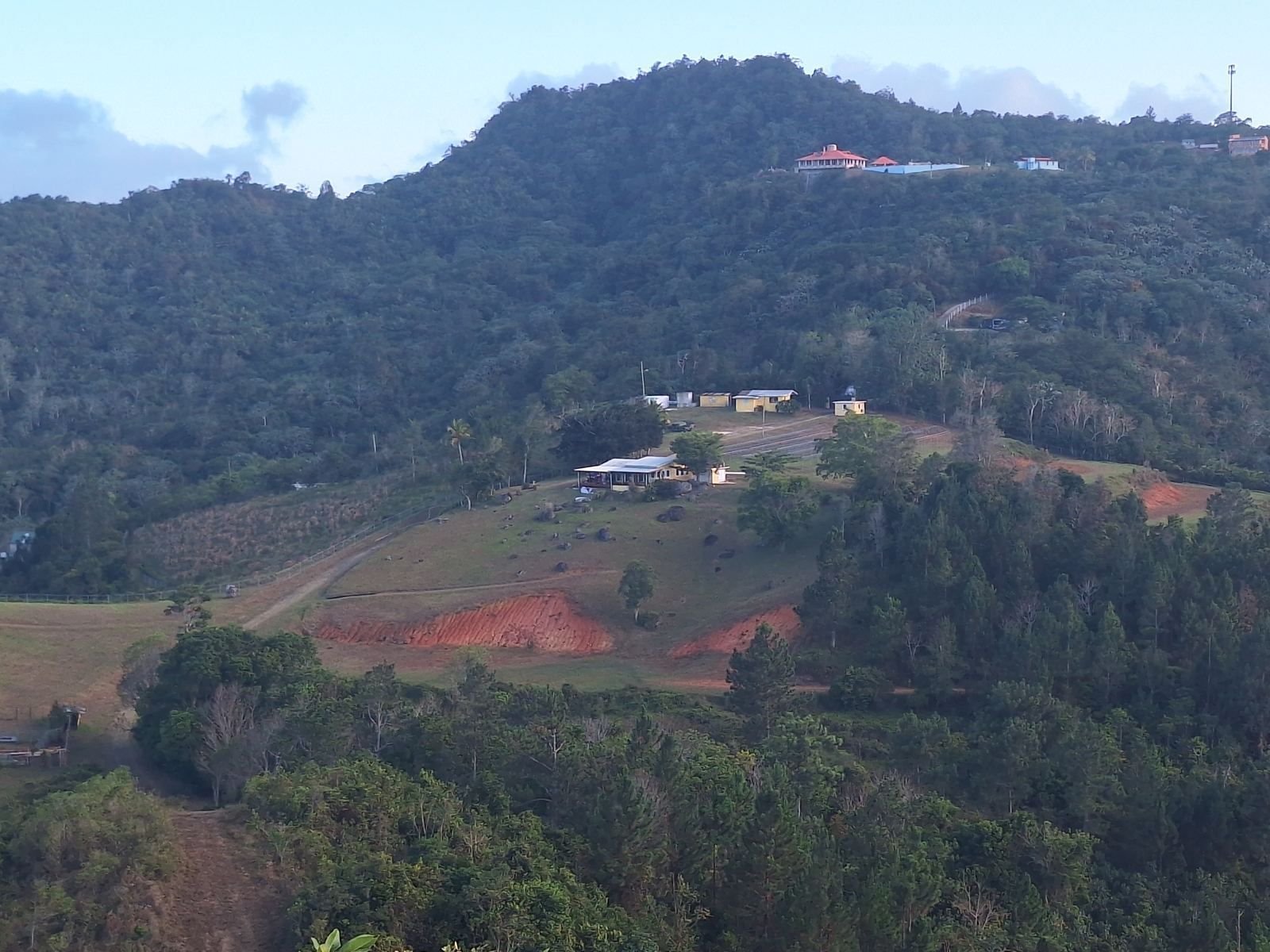
The estate described on this site in Cayey is held as two fee-simple parcels totaling about 100 acres, or roughly 103 cuerdas, at about 2,100 feet on PR-7722 near the Aibonito line. Two separately recorded parcels give a buyer flexibility (one could be financed, leased or sold independently of the other without a new segregation), and they mean the title study covers two fincas rather than one. As with any rural purchase, the listing materials themselves advise buyers to verify acreage, zoning and improvements independently, and the owners will make the title and survey documents available to a serious buyer's attorney. The property is for sale at $2,375,000, reduced from $2,500,000, on a furnished long-term lease at $15,000 per month, or as a lease with option to buy, and is listed on Stellar MLS as PR9124119. Details and photographs are on the main page, and you can request documents or a visit through the inquiry form.
Frequently asked questions
What is the Registro de la Propiedad?
What does a title study in Puerto Rico show?
Why does the survey show a different area than the deed?
Who prepares the title study and who pays?
Can I buy land that is not recorded in the Registry?
Do I need title insurance in Puerto Rico?
Sources and further reading
- Act 210-2015, Ley del Registro de la Propiedad Inmobiliaria (Office of Management and Budget, Government of Puerto Rico).
- Demarcaciones y secciones del Registro de la Propiedad, Puerto Rico Department of Justice.
- Digitalizado el Registro de la Propiedad de PR, NotiCel, 2016, on the Karibe system.
- Ex parte Román Quiles, 2025 TSPR 45, Supreme Court of Puerto Rico, on the expediente de dominio, surveys and rectification of area.
This article is general information, not legal advice. Registry procedures, fees and requirements change; a Puerto Rico attorney-notary should examine title and a licensed Puerto Rico surveyor should measure the property before any purchase. Information about the Cayey estate is provided by the owner and should be independently verified.