A viable eco-lodge, retreat or agrotourism site in Puerto Rico needs the right zoning for overnight guests, land outside the flood zone, dependable water and wastewater, safe road access, and an actual working farm or natural feature that gives guests a reason to come. The Puerto Rico Tourism Company runs a formal agrotourism certification with specific requirements, Act 60 offers tourism incentives for qualifying projects, and every structure needs permits. This guide explains how those pieces fit together, what disqualifies a site, and how to evaluate land before you buy it for a hospitality project.
What counts: agrotourism, eco-lodges, retreats and villas
Several different businesses get grouped under "eco" or "retreat," and they are regulated differently:
- Agrotourism (agroturismo). Visitors come to a working farm to see, learn about or take part in agricultural activity: coffee and cacao tours, harvest experiences, beekeeping, livestock, farm-to-table meals. Puerto Rico law added an agrotourism program to the Department of Agriculture's mandate in 2003 (Act 195-2003), describing farm stays and experiences on coffee haciendas, cattle and Paso Fino horse farms and fishing villages.
- Agro-lodging (agrohospedaje). Overnight rooms on a working farm, paired with an agrotourism offering on the same property.
- Eco-lodges. Small lodgings built around a natural setting, with an emphasis on low-impact construction, energy and water efficiency, and nature-based activities.
- Retreat and wellness centers. Lodging plus programming such as yoga, meditation, workshops or corporate retreats. Regulatory treatment depends on the lodging component and any food service.
- Short-term rentals and villas. A house or cottages rented to guests for fewer than 90 consecutive days. The Tourism Company keeps a registry of short-term rentals and collects room tax.
The Tourism Company lists eco-lodges and agro-lodgings as its sustainable tourism lodging categories, alongside standard categories such as bed and breakfasts, guest houses and tourism villas, and promotional brands such as Paradores (7 to 75 rooms, outside the San Juan metro area) and Posadas (7 to 50 rooms, in town centers).
The Tourism Company's agrotourism certification
The Puerto Rico Tourism Company (CTPR) certifies agrotourism businesses under a program run by its sustainable tourism division, using a guide developed with the Departments of Agriculture, Health and Natural and Environmental Resources, USDA and the University of Puerto Rico. Certification brings official recognition and promotion, and the agency has periodically offered small grants to certified businesses, such as the $5,000 checks it gave each of 25 certified companies in 2021. As of late 2020 the program counted 26 certified businesses, up from 10 at the start of 2017, so it remains a small, distinctive category.
Under the published guide, the main requirements include:
- A real farm. The applicant must be a bona fide farmer or agricultural producer, or work with one under a written agreement showing how the producer benefits, and must earn at least $1,000 a year from agricultural sales.
- General documents. Proof of land ownership, a municipal license (patente), public liability insurance naming CTPR as additional insured, a hold harmless agreement, and a description of the services offered.
- Safety and facilities. First aid, visitor restrooms, and for any structure an OGPe permit, a Health Department sanitary license and a Fire Department inspection certificate.
- Operations. A defined tour route and schedule, a visitor code of conduct, educational signage and staff who understand the farm.
- Activity-specific permits, for example DRNA water extraction permits for crops, a manure management plan for livestock, and air permits for larger emergency generators.
- Agro-lodging. At least three rooms on the working farm, compliance with lodging standards, certification under the Tourism Company's green lodging program, and an agrotourism experience on the same property.
Requirements are periodically revised, so request the current guide from the Tourism Company before you plan around it.
What disqualifies a site
The same guide lists conditions that rule a project out of certification, and they double as a good first screen for any rural hospitality site:
- Location in a FEMA flood zone, or in zones designated for resource preservation.
- Environmental violations or harm to endangered species habitat.
- Four-wheelers or similar vehicles as part of the tour, and any animal fighting.
- Agro-lodging in certain agricultural and conservation zones where it is barred.
- Heavily mechanized, monoculture or intensive production beyond a basic level.
Mountain properties above the floodplain start with an advantage on the first point, which knocks out many coastal and river-valley parcels.
Zoning and permits
Overnight guests are the dividing line. A farm tour on agricultural land is close to the land's intended use; rooms, a restaurant, an event venue or a wellness center are not, and need to be checked against the parcel's zoning. Districts such as R-G (Rural General) frequently list agro-tourism and lodging among their permitted or conditional uses. A-G (Agrícola General) and A-P (Agrícola Productivo) are more restrictive, and some conservation districts permit eco-tourism uses explicitly. Whether a given project is allowed as of right, allowed with conditions or needs a location consultation (consulta de ubicación) depends on the district, the soil classification and the municipal plan. Our guide to Puerto Rico zoning codes for rural land explains how to look this up.
Beyond zoning, plan for construction or use permits through OGPe or the municipality, a sanitary license for lodging and any food service, Fire Department inspection, an approved septic or wastewater system sized for guests, potable water certification if guests drink well water, room tax registration with the Tourism Company, and liability insurance. Budget time as well as money; a project that needs a consultation can take many months before construction starts.
Incentives: Act 60 and Tourism Company programs
The Puerto Rico Incentives Code (Act 60-2019) includes a tourism development chapter, administered with the Department of Economic Development and Commerce (DDEC). Eligible activities named by the Tourism Company include paradores, bed and breakfasts, guest houses, agro-hostels, sustainable tourism and natural resource attractions, among others. Qualifying projects can receive a decree with income tax, property tax and municipal tax exemptions and, for larger investments, transferable tax credits, for a term of 15 years renewable for another 15. Applications go through a pre-application and formal application, evaluated on return on investment, permits in hand and job creation.
These benefits are meaningful for a funded project with a business plan; they are not automatic for a few rental cabins. A farm operation may separately qualify for the bona fide farmer incentives described in our property tax guide. Work with a Puerto Rico incentives attorney to see which, if any, apply.
What a viable site looks like
- A reason to visit. A working farm, horses, a river or waterfall, forest trails, long views, a cool climate. Guests pay for the experience, not the bed.
- Elevation and climate. Cooler mountain sites appeal to island residents escaping the coastal heat as well as to visitors, which supports weekday and off-season demand.
- Access within about an hour of San Juan. Most visitors arrive through Luis Muñoz Marín International Airport. Sites reachable by expressway with a short final stretch of mountain road are easier to sell than remote ones.
- Water and wastewater capacity. Municipal service plus a well and storage, and soil suitable for a septic system sized for guests.
- Power resilience. Guests expect lights, refrigeration and connectivity during outages. A generator, solar with batteries and satellite internet are standard on successful rural lodgings. See our guide to off-grid and self-sufficient properties.
- Existing structures. A legal main house and secondary residences can become guest rooms, a lodge or staff housing much faster than new construction.
- Privacy and separation. Enough land that guests, the farm and the owners can coexist without crowding, and that neighbors are not disturbed.
- Clean title and permits. Confirm that existing structures were permitted, since an unpermitted building can stall a sanitary license.
Thinking about the numbers
Small rural lodgings in Puerto Rico live on occupancy and rate, with costs driven by staffing, utilities, insurance, maintenance and marketing. A simple way to test a site is to price the experience against existing mountain lodgings and farm stays, estimate realistic occupancy for weekdays and weekends separately, and subtract operating costs and the room tax. Many owners start with the lowest-risk version, such as guided farm tours, a single villa rental or occasional retreats, and add rooms once demand is proven. That sequence also lets the agrotourism certification and permits follow the business rather than precede it.
A worked example: 100 acres in Cayey
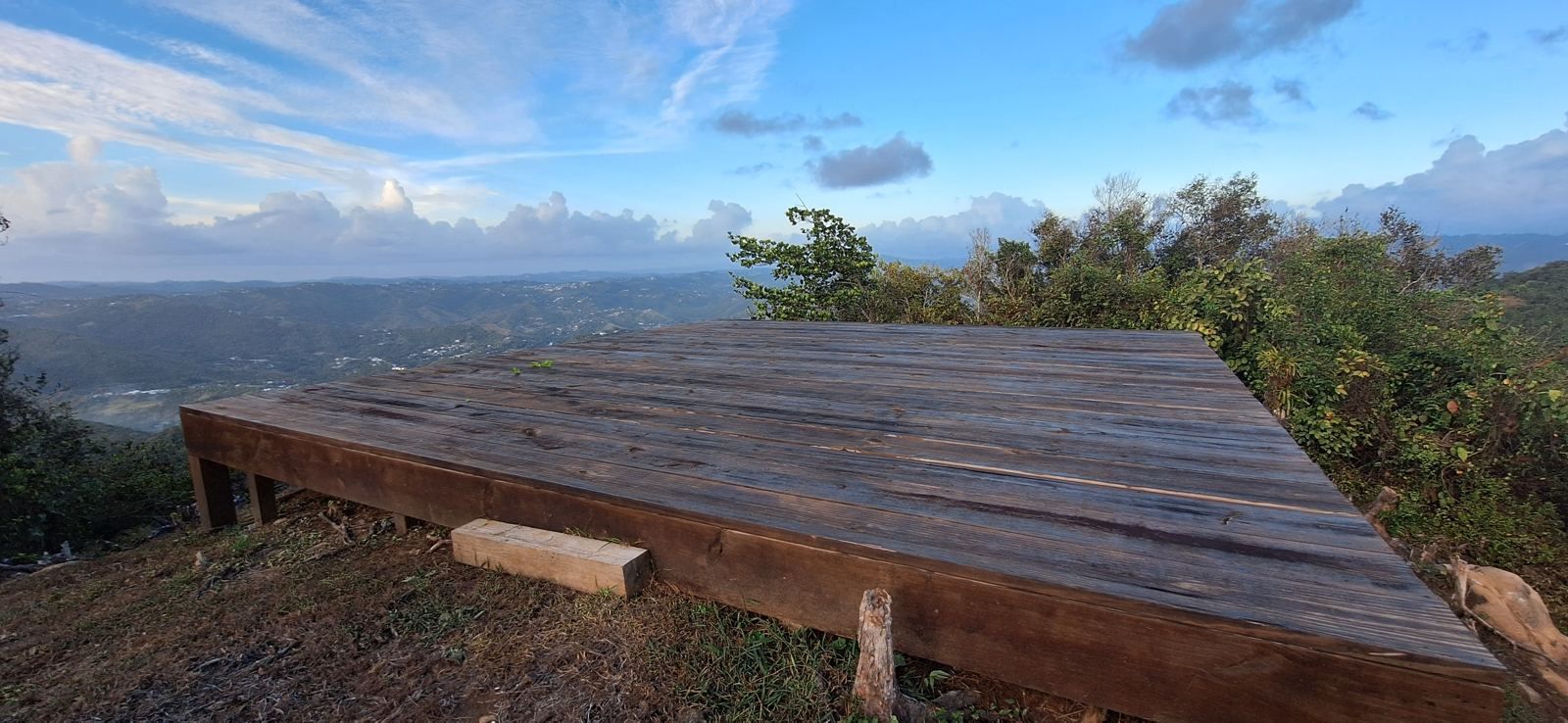
The estate this site describes is a candidate for exactly this kind of project. It covers about 100 acres in two fee-simple parcels at roughly 2,100 feet in Cayey, about an hour from San Juan, outside the coastal floodplain. The owners' zoning confirmation shows A-G agricultural land paired with a B-Q district that permits eco-tourism, equestrian and related uses. The land previously operated as a working farm with horses, cattle and chickens, supplying produce to San Juan restaurants, and it has trails with footbridges, two creeks, a summit lookout platform, open pasture and long valley views. Infrastructure includes municipal water, a 550-foot well, a 12,000-gallon cistern, a generator hookup and Starlink. A remodeled three-bedroom main house and a second residence for renovation provide a starting point for guest or staff accommodation, and property tax is about $990 a year.
It is offered for sale at $2,375,000, reduced from $2,500,000, on a furnished long-term lease at $15,000 per month, or as a lease with option to buy, which lets an operator test demand before purchasing (Stellar MLS PR9124119). See the main page for photographs, or arrange a visit. For comparable properties, see mountain farms and estates for sale in Puerto Rico, and for due diligence, buying a farm or mountain estate in Puerto Rico.
Frequently asked questions
Do I need a license to run agrotourism in Puerto Rico?
How many rooms does an agro-lodging need?
Can I build guest cabins on agricultural land?
Are there tax incentives for eco-tourism projects?
What disqualifies a site from agrotourism certification?
Can I lease a property first to test an eco-tourism concept?
Sources and further reading
- Guía para el establecimiento de un proyecto agroturístico, Puerto Rico Tourism Company.
- Lodging categories and their definitions, Puerto Rico Tourism Company.
- Law 60 tourism incentives, Puerto Rico Tourism Company.
- Ley 195-2003, adding an agrotourism program to the Department of Agriculture (Spanish).
- Puerto Rico Tourism Co. doles out $125K in agrotourism incentives, News is my Business, 2021.
- Crece el agroturismo en la isla, El Nuevo Día, December 2020.
This article is general information, not legal, tax or investment advice. Zoning, permit, certification and incentive requirements change; confirm them for any specific parcel and project with the Puerto Rico Tourism Company, DDEC and a Puerto Rico attorney or licensed planner before purchasing. Information about the Cayey estate is provided by the owner and should be independently verified.