Owner financing, also called seller financing or seller carryback, means the seller acts as the bank for part of the price. The sale closes, the buyer takes title, and the buyer pays the seller over time under a promissory note secured by a mortgage on the property. In Puerto Rico it is common on farms, land and large estates, because local banks lend cautiously on rural acreage and mainland lenders rarely lend on the island at all. This guide explains how the documents work under Puerto Rico's civil-law system, what terms are typical, what happens if the buyer defaults, and how owner financing fits alongside a lease with option to buy.
Why owner financing is common on rural property
Puerto Rico banks will finance a primary residence on an ordinary lot. They are far more conservative about raw land, large acreage, working farms and properties with more than one house, and appraisals of unusual rural estates are hard to support with comparable sales. Mainland lenders generally do not lend on Puerto Rico property. So many rural sales close in cash, and many of the rest close with the seller carrying part of the price.
For the buyer, owner financing means closing now without waiting on a bank, often with more flexible underwriting, and the chance to refinance later once they have island income, residency and a track record on the property. For the seller, it widens the pool of buyers, can support a better price, and produces interest income. It also leaves the seller's equity in the property until the note is paid, which is why the terms matter.
The documents: note, mortgage deed and recording
Puerto Rico is a civil-law jurisdiction, and real property transactions follow a fixed path through a notary (who in Puerto Rico is always an attorney) and the Property Registry. An owner-financed sale typically involves:
- The purchase and sale deed (escritura de compraventa), transferring title to the buyer.
- A promissory note (pagaré), in which the buyer promises to pay the financed amount with interest on stated terms. Notes secured by mortgages in Puerto Rico are often made payable to bearer or to order, so the seller can later sell or pledge the note.
- A mortgage deed (escritura de hipoteca), a public deed executed before the notary that ties the note to the property.
- Recording in the Property Registry. Under Puerto Rico's Real Property Registry Act (Act 210-2015), recording is what creates a mortgage as a lien. An unrecorded mortgage deed does not give the seller the security interest. The notary presents the sale and the mortgage together so the seller's lien is in place from closing, and the stamps and recording fees for the mortgage are a closing cost to allocate in the contract.
Because the buyer now owns the property, they also take over the CRIM property tax account, insurance and utilities at closing. The due diligence is the same as for a cash sale: title study, survey, zoning, water and access. It is described in How to buy land in Puerto Rico from the mainland.
Typical terms
Everything is negotiable, but most owner-financed deals on Puerto Rico rural property fall into a recognizable pattern:
- Down payment. Usually 20 to 40 percent of the price. Sellers of large estates often want the higher end, because the down payment is their cushion if they ever have to foreclose.
- Interest rate. Often near or somewhat above current bank mortgage rates, reflecting the seller's risk and the flexibility offered. Ask your attorney whether any interest-rate limits or lending regulations apply to your transaction, especially when the property is a residence.
- Amortization. Monthly payments calculated as if over 15 to 30 years, which keeps them manageable.
- Balloon. The remaining balance due in a lump sum after three to seven years. The buyer plans to refinance with a bank or pay it off from other funds by then. This keeps the seller from becoming a 30-year lender.
- Prepayment. Usually allowed without penalty, since both sides want the balloon paid early if possible.
As an illustration only: on a $2,000,000 sale with 30 percent down, the seller would carry $1,400,000. At 7 percent amortized over 30 years, the monthly payment would be roughly $9,300, with the remaining balance of about $1,300,000 due as a balloon at year five. Run your own numbers with your actual rate and term.
Clauses that protect each side
- Insurance and taxes. The buyer keeps the property insured against hurricane and fire with the seller named as mortgagee, and pays CRIM property tax on time. Some sellers require monthly escrow deposits for both.
- Due on sale. The note becomes due if the buyer sells or transfers the property, so the seller is not left financing a stranger.
- Waste and improvements. The buyer may not demolish structures, cut timber or remove soil beyond normal farming without consent, but is free to improve the property.
- Default and cure. A clear definition of default, a grace period, a written notice and a cure period before the seller can accelerate the note.
- Proof of funds and financing plan. Sellers should ask how the buyer intends to pay the balloon. Buyers should be able to answer.
- Subordination. Whether the seller will let a bank take first position for construction or improvement loans. Most sellers say no, or only for a limited amount.
- Personal guarantee or additional collateral when the buyer is an entity, at the seller's option.
- Brokers. How any commission is paid at closing, since the seller may receive less cash at closing than in an all-cash sale.
Default and foreclosure in Puerto Rico
This is the part sellers should understand before agreeing to carry a note. Puerto Rico does not allow the out-of-court, power-of-sale foreclosures common in some mainland states. If the buyer stops paying, the seller files suit to foreclose (ejecución de hipoteca) in the Court of First Instance. The Registry Act also provides a summary foreclosure procedure for mortgages that meet its requirements, which your attorney may be able to use.
If the property is the buyer's principal residence, Act 184-2012, the compulsory mediation law, requires the court to hold a mediation session between lender and borrower before it can enter a foreclosure judgment. The Puerto Rico Supreme Court has held that a foreclosure judgment entered without the required mediation can be void. After judgment, the property is sold at a judicial auction, and the proceeds pay the debt, interest and costs.
Even when everything goes smoothly, foreclosure in Puerto Rico commonly takes a year or more, and contested cases take longer. During that time the seller may not be receiving payments and may have to protect the property's insurance and taxes. That is why sellers insist on a meaningful down payment, keep the balloon short, and prefer buyers with verifiable funds. Buyers should read the default and cure provisions as carefully as the interest rate.
Tax treatment at a high level
For the seller, interest received is ordinary income each year. The gain on the sale may qualify for installment treatment, reported as principal payments arrive rather than all in the year of closing, but which system applies depends on whether the seller is a Puerto Rico bona fide resident, a mainland taxpayer or an Act 60 decree holder, and how the property was held. For the buyer, mortgage interest on a residence may be deductible under the rules that apply to them. These questions turn on individual facts, so involve a CPA who works with both Puerto Rico and federal returns before you agree on terms.
Combining owner financing with a lease option
Owner financing and a lease with option to buy solve different problems, and they work well together. In a lease option, the owner keeps title and the tenant has the right, but not the obligation, to buy later at an agreed price. With owner financing, the sale closes now and the seller holds a mortgage. A common sequence on rural estates is to start with a lease option, which lets the buyer live on the land, establish residency and test the property, and then, when the option is exercised, close with the seller carrying part of the price. That gives the buyer a further three to five years to arrange bank financing. Writing the owner-financing terms into the option agreement from the start avoids a second negotiation later. For the broader picture, see Buying a farm or mountain estate in Puerto Rico.
Example: a 100-acre estate in Cayey
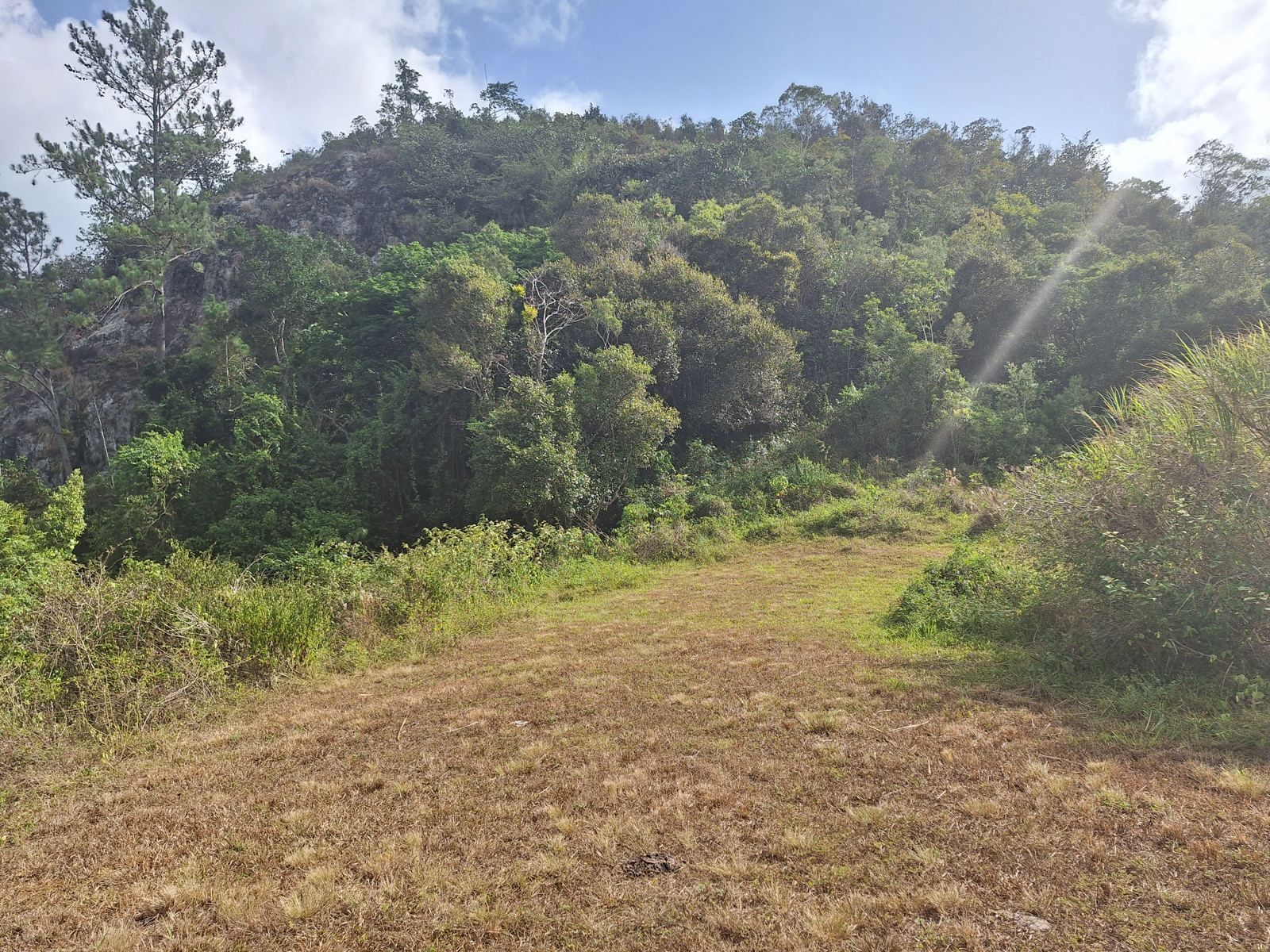
The owners of the estate described on this site offer owner financing as one of several routes. The property is about 100 acres in two fee-simple parcels at roughly 2,100 feet on PR-7722 in Cayey, an hour from San Juan, with a remodeled three-bedroom main house offered furnished, a second residence, A-G agricultural and B-Q zoning, a 550-foot well, a 12,000-gallon cistern, two creeks and Starlink internet. Property tax is about $990 a year, and it is on Stellar MLS as PR9124119. It is offered for sale at $2,375,000, reduced from $2,500,000; on a furnished long-term lease at $15,000 per month; or as a lease with option to buy. Owner financing of part of the price can be discussed for a buyer with a substantial down payment and a plan for the balloon. Photographs and details are on the main page; to propose terms, use the inquiry form.
Frequently asked questions
Is owner financing legal in Puerto Rico?
Does a seller-held mortgage have to be recorded?
What are typical owner financing terms?
What happens if the buyer stops paying?
How is owner financing different from a lease with option to buy?
How is a seller taxed on an owner-financed sale?
Sources and further reading
- Act 210-2015, Ley del Registro de la Propiedad Inmobiliaria, Government of Puerto Rico (Spanish).
- El impacto de la nueva ley hipotecaria en la función notarial, Revista Jurídica de la Universidad de Puerto Rico (Spanish).
- Act 184-2012, Ley para Mediación Compulsoria y Preservación de tu Hogar, via the Office of the Commissioner of Financial Institutions (Spanish).
- Preguntas y respuestas frecuentes sobre la Ley 184-2012, Poder Judicial de Puerto Rico (Spanish).
- Puerto Rico Supreme Court rules that a foreclosure judgment could be null and void if the case was not mediated first, McConnell Valdés.
- Puerto Rico Supreme Court defines good faith in compulsory foreclosure mediation cases, News is my Business.
This article is general information, not legal, tax or financial advice. Owner-financed transactions in Puerto Rico should be documented by a Puerto Rico attorney and notary, and both parties should have their own counsel and tax advice. The payment example is illustrative only. Terms for the Cayey estate are subject to negotiation, and information about the property is provided by the owner and should be independently verified.