In Puerto Rico, "off-grid" usually means grid-optional: a property connected to LUMA power and municipal water that can keep running for days or weeks without either. The ingredients are solar panels with batteries or a generator (ideally both), a well or other independent water source with storage, satellite internet, and road access that survives heavy rain. After Hurricane María in 2017 and two island-wide blackouts between December 2024 and April 2025, this kind of resilience has moved from a niche preference to a mainstream requirement. This guide covers what works, what to verify, and how to judge a property's self-sufficiency before you buy.
Why self-sufficiency matters in Puerto Rico
Puerto Rico's electric grid has a long record of fragility. Hurricane María knocked out power to nearly the entire island in September 2017, and restoration in some rural areas took months. More recently, an island-wide outage hit on New Year's Eve 2024, and on April 16, 2025 a second blackout cut power to all of LUMA Energy's roughly 1.4 million customers, with officials estimating 48 to 72 hours to restore most service. Water service depends on electric pumps, so outages and droughts often affect both at once.
Residents have responded by building their own capacity. According to the U.S. Energy Information Administration, Puerto Rico had about 192,000 rooftop solar systems and 1,456 megawatts of rooftop solar capacity at the end of 2025, roughly one fifth of the island's generating capacity, and about 171,000 homes and businesses had battery storage. For a rural property buyer, that means the equipment, installers and know-how are widely available, and a property that already has them installed and working is worth more.
Power: grid, solar, batteries and generators
- Grid connection. Even off-grid-minded buyers usually want LUMA service as a backstop. Confirm the meter, service size and that the line to the property is in reasonable condition. Remote properties without a connection can be expensive to connect, and "no grid service" on a listing is a cost, not just a lifestyle.
- Solar with batteries. The most common resilience setup on the island. Panels charge batteries during the day and the batteries carry essential loads at night and during outages. The key questions are how many kilowatts of panels, how many kilowatt-hours of batteries, which circuits are backed up, the age and warranty of the equipment, and whether the system was permitted and interconnected. A system sized for refrigerators, lights, fans, internet and a well pump is far smaller and cheaper than one sized for whole-house air conditioning; at elevation, where many homes need little or no air conditioning, solar goes further.
- Generators. A generator, either installed with an automatic transfer switch or portable with a hookup, covers long cloudy stretches and heavy loads such as large pumps. Fuel availability after storms is the weak point, so many owners pair a generator with solar and keep it as the second line of defense. Larger generators can require an air permit, worth checking on agricultural or commercial properties.
- Wind. High, exposed ridges sometimes suit small wind turbines, but they are far less common than solar and must be rated for hurricane conditions.
Net metering and interconnection
Puerto Rico's net metering program credits solar owners for power they send to the grid at the retail rate. In January 2024 the legislature passed Act 10-2024, extending the existing program through 2031 and barring the Energy Bureau from beginning a comprehensive review before 2030. The Financial Oversight and Management Board challenged the law in federal court later in 2024, so buyers should confirm the program's current status before relying on it in their numbers. Interconnection is handled by LUMA; in 2025 LUMA's practice of charging $300 for supplementary studies on some solar installations drew legislative objections. If a property has solar, ask for the interconnection agreement and recent bills showing net metering credits.
Water: wells, cisterns, creeks and rain
Water independence matters as much as power. Municipal service from the Aqueduct and Sewer Authority (AAA) relies on pumps and reservoirs, so it can fail during outages and is rationed during droughts; in 2026 the Department of Agriculture reported about 80 percent of the island in drought conditions. A self-sufficient property typically has:
- A drilled well, documented by depth, yield and pump specifications, with a pump that can run on solar or a generator. Water quality should be tested before purchase. Extraction beyond basic domestic use may require a franchise from the Department of Natural and Environmental Resources (DRNA).
- A cistern or storage tanks, sized to carry the household (and any animals) through several days or weeks without resupply, with a pressure pump.
- Rainwater collection from roofs into storage, often with filtration for household use. Mountain areas with high rainfall make this effective most of the year.
- Creeks or springs for irrigation and livestock, recognizing that surface water can run low in dry spells and carry contamination after storms.
- Filtration and treatment such as sediment filters, UV or reverse osmosis for drinking water from wells or rain.
Wastewater and septic
Most rural properties use septic systems rather than municipal sewer. Ask for the location, age and capacity of the tank and leach field, and whether it was permitted. A system sized for a family will need expansion for guest units or events. Soil and slope affect where new systems can go, which matters if you plan to add structures.
Internet and communications
Fiber rarely reaches mountain roads, and mobile coverage can be patchy in valleys. Satellite internet, chiefly Starlink, has become the standard rural solution and works well from high, open sites; it also keeps running during grid outages if the dish and router are on battery backup. Before buying, check that a dish location has a clear view of the sky, test mobile signal from several points on the property, and consider a second provider for redundancy if you work remotely.
Roads, access and supplies
Self-sufficiency fails if you cannot get in or out. Mountain roads in Puerto Rico are paved but narrow and steep, and heavy rain brings landslides and washouts. Check the condition of the public road, whether the driveway is on the parcel or covered by a recorded easement, whether it drains properly, and whether there is more than one route to town. A chainsaw, a vehicle with good clearance and a relationship with neighbors are part of the system.
What works after a hurricane
The lessons from María, Fiona in 2022 and the recent blackouts are consistent:
- Layered power. Solar with batteries for daily resilience, plus a generator and stored fuel for long outages.
- Stored water and a pump that does not need the grid.
- Structures built or retrofitted for wind, with secured roofs, shutters and panels mounted to withstand hurricane-force winds.
- High ground. Interior mountain properties avoid storm surge and coastal flooding, though drainage and landslide exposure still need checking.
- Communications on battery, so you can call for help and coordinate supplies.
- Food and fuel reserves for at least two weeks, and the ability to grow some of your own.
A buyer's checklist
- LUMA account, meter and recent bills.
- Solar system specifications, battery capacity, installer, warranty, permits and interconnection agreement.
- Generator size, fuel type, transfer switch and service records.
- Well depth, yield, pump, water test and any DRNA franchise.
- Cistern capacity and pump, rainwater system and filtration.
- Septic location, capacity and permit.
- Internet provider, dish placement and mobile coverage.
- Road condition, easements and alternate routes.
- Flood zone, drainage and landslide history.
- How the property performed during María, Fiona and the 2024 and 2025 blackouts. Ask the seller and the neighbors.
A worked example: 100 acres in Cayey
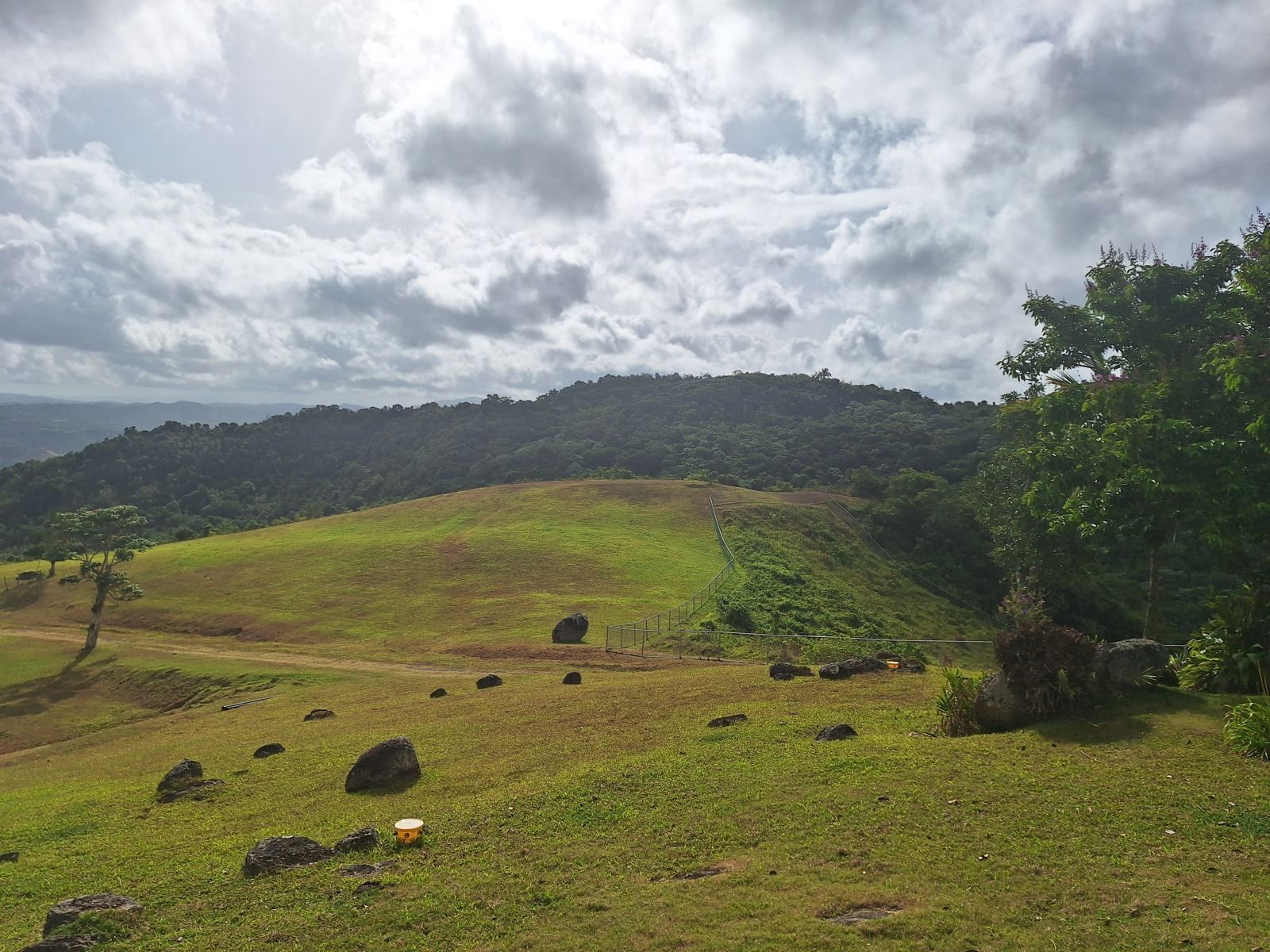
The estate this site describes was set up for year-round living on or off the grid. It covers about 100 acres in two fee-simple parcels at roughly 2,100 feet in Cayey, well above the coastal floodplain, about an hour from San Juan. It has LUMA electricity with a generator hookup, municipal water plus a 550-foot well and a 12,000-gallon cistern, two natural creeks, Starlink internet and remotely accessible cameras and alarm. The elevation keeps the house cool enough that heavy air-conditioning loads are not a given, and the exposed ridges suit additional solar or wind for an owner who wants to go further. The land is zoned A-G agricultural with a B-Q district, which allows growing food and keeping livestock, and annual property tax is about $990.
It is offered for sale at $2,375,000, reduced from $2,500,000, on a furnished long-term lease at $15,000 per month, or as a lease with option to buy (Stellar MLS PR9124119). See the main page for photographs and details, or schedule a private visit. For other properties on the market, see mountain farms and estates for sale in Puerto Rico, and for the full due diligence process, buying a farm or mountain estate in Puerto Rico and how to buy land in Puerto Rico from the mainland.
Frequently asked questions
Can you live fully off the grid in Puerto Rico?
How common is solar in Puerto Rico?
Does Puerto Rico still have net metering?
How often does the power go out in Puerto Rico?
Do I need a permit for a well in Puerto Rico?
Does Starlink work in the Puerto Rico mountains?
Sources and further reading
- Rooftop solar accounts for 20% of Puerto Rico's capacity mix, U.S. Energy Information Administration, April 2026.
- Puerto Rico island-wide power outage, CBS News, April 2025.
- As states slash rooftop solar incentives, Puerto Rico extends them, Grist, February 2024.
- Oversight board sues over Puerto Rico net metering law, Canary Media, August 2024.
- Legislation to stop LUMA's $300 charge to solar customers, Metro Puerto Rico, September 2025.
- La sequía que estrangula la agricultura puertorriqueña, Metro Puerto Rico, August 2026.
This article is general information, not engineering, legal or financial advice. Energy policy, permitting and equipment standards in Puerto Rico change; confirm requirements with LUMA, DRNA, a licensed installer and a Puerto Rico attorney before purchasing or installing systems. Information about the Cayey estate is provided by the owner and should be independently verified.