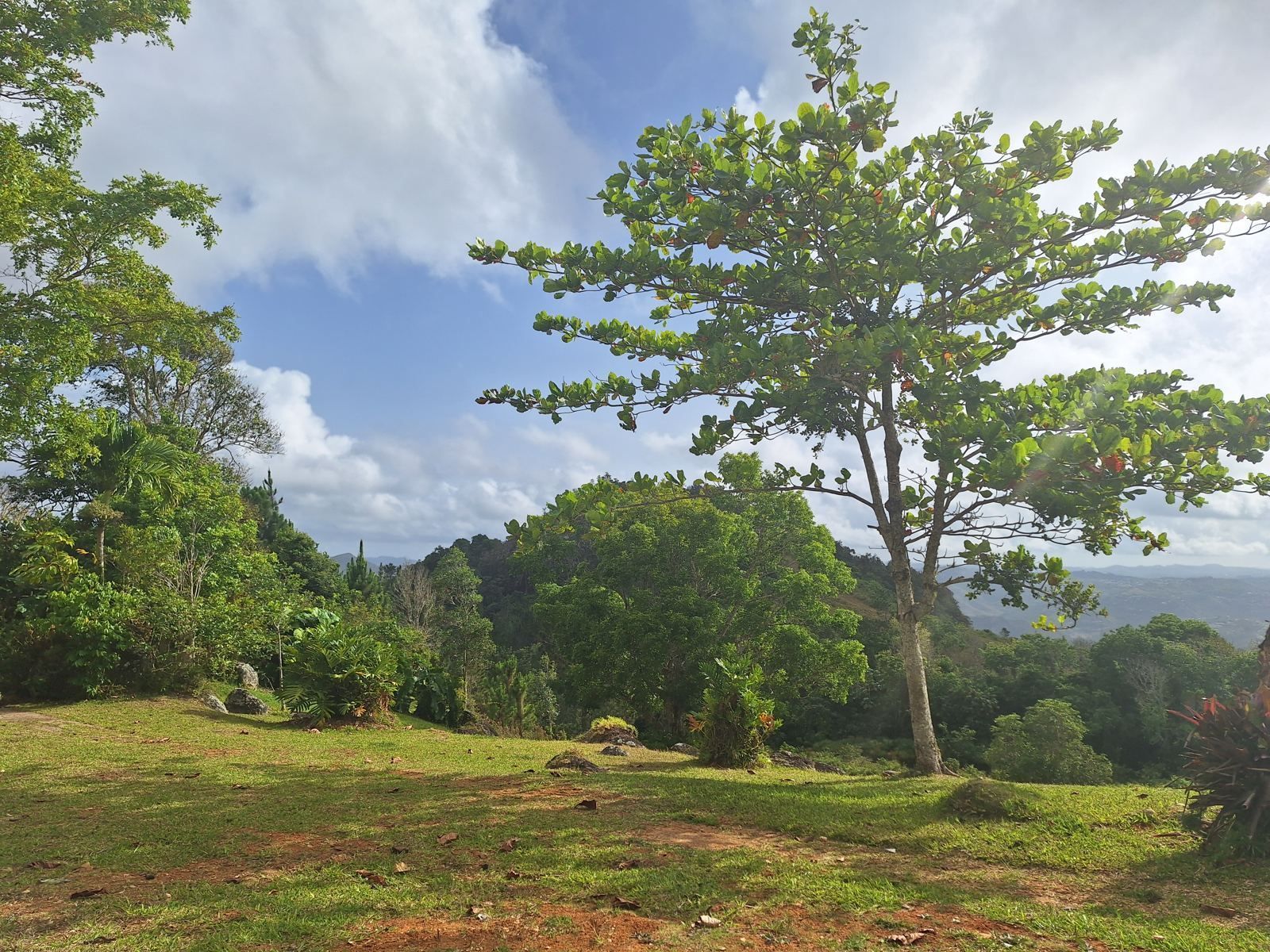
A mountain farm in Cayey can grow more than most mainland buyers expect: coffee on the ridges, plantains and root crops on the terraces, greens and herbs that wilt on the coast, citrus and avocados, and pasture for cattle, horses and poultry. What it supports, and how well, comes down to three things: the elevation, the rain and the slope. This guide walks through each, crop by crop, and covers the incentives and markets that make a small farm here pay.
The climate you are working with
Cayey's town sits at about 1,500 feet in the Sierra de Cayey, and the farm country around it climbs past 2,000 feet toward Aibonito. Long-term averages for the town show daytime highs of about 78°F in January rising to the mid 80s in summer, with overnight lows around 60°F in winter and the high 60s in summer. Annual rainfall is around 100 inches, concentrated from May through November, with a cooler, drier stretch from December through March. Higher ridge sites run cooler still, and morning mist is common, which is why Cayey is called the City of Mists.
For a grower, that means no frost, no true dry season, high humidity and plenty of water most of the year, with occasional hard rain events (Cayey's 24-hour record is close to 21 inches) and the hurricane season to plan around. Historically the municipality's farms grew tobacco, sugarcane, coffee and fruit; today agriculture is a smaller share of the local economy, but the conditions that supported it are unchanged. For a fuller picture of the climate and daily life, see Living in Cayey, Puerto Rico.
Coffee: where Cayey fits
Puerto Rico was once among the world's leading coffee exporters, and the industry is concentrated today in the western central mountains, in Yauco, Adjuntas, Lares, Las Marías and San Sebastián, at roughly 2,400 to 2,800 feet. The island grows Arabica, principally Bourbon, Typica, Pacas and Catimor varieties.
Cayey sits at the low end of that band. It was a significant coffee producer in the 19th century, and ridge sites around 2,000 feet can still grow good coffee, particularly with partial shade, good drainage and protection from the strongest winds. The trade-off is that coffee grown lower tends to ripen faster and yield more, with a milder cup than the high-altitude farms of Adjuntas or Jayuya. For a small estate grower roasting for their own table or a local café, that is not a drawback.
The real constraint on Puerto Rican coffee is labor: picking is done by hand, ripe cherries must be harvested over several passes, and growers report losing large parts of the crop for lack of pickers. The Department of Agriculture pays harvesters a per-almud incentive on ripe coffee, $1.50 per almud in the 2026 to 2027 program, and has distributed hundreds of thousands of seedlings to growers in recent years to replant farms lost to hurricanes. A grower planning more than a few hundred trees should plan the harvest before planting.
Plantains and bananas
Plantains (plátanos) and bananas (guineos) are the backbone of Puerto Rican mountain farming and do well in Cayey's conditions. They perform best between about 70°F and 86°F, and rainfall is the most important factor in yield, which suits a site with 100 inches a year. The island's dominant plantain clone is 'Maricongo', which accounts for about 90 percent of production.
The risks are physical. Strong winds snap the pseudostems, making plantain fields among the first casualties of any tropical storm. Waterlogged soil kills roots, and heavy rain on steep, bare slopes strips topsoil. The best plantings sit on sheltered, well-drained terraces or contour rows, with windbreak trees on the exposed side and ground cover between rows. A plantain plant fruits once, so growers manage a rolling succession of suckers to keep harvests coming through the year.
Root crops and staples
The traditional farináceos of the Puerto Rican table thrive in mountain soils: yautía (tannia), malanga, ñame (yam), yuca (cassava), batata (sweet potato) and, on drier spots, pigeon peas (gandules), the essential ingredient in arroz con gandules. These crops tolerate the wet season, store well, and sell steadily at farmers' markets. Yuca and gandules are forgiving enough for a first season; ñame and yautía reward a grower who learns the local planting calendar from neighbors.
Vegetables and herbs
Elevation is the mountain grower's advantage with vegetables. The cooler nights at 1,500 to 2,100 feet allow crops that bolt, scorch or fail to set fruit in coastal heat: lettuce and other salad greens, cabbage, herbs such as cilantro, culantro and basil, sweet and hot peppers, and tomatoes, which do best under simple rain covers that keep the foliage dry. The cool, drier months from December through March are the easiest window for leafy greens and are when many growers plant tomatoes and peppers.
The main challenge is water in excess, not in short supply. Raised beds, good drainage, mulch to stop soil splash and at least a small hoop house or shade structure will lift yields considerably during the rainy months.
Fruit trees
Citrus (oranges, grapefruit, limes and the sour naranja agria), avocados, mangoes on the warmer, lower slopes, guavas, soursop (guanábana), passion fruit (parcha), breadfruit (panapén) and acerola all grow in the Cayey mountains. Ornamentals do too: bougainvillea, torch ginger and heliconias flourish at this elevation and are worth considering for anyone thinking about cut flowers or agro-tourism. Fruit trees also double as windbreaks and shade for coffee.
Livestock and pasture
Steady rain keeps mountain pasture green most of the year, which is why cattle, horses and goats are a common sight on Cayey's back roads. Pasture management matters more than acreage: rotate paddocks to prevent overgrazing on slopes, keep animals out of creek banks, and provide shade and shelter. Laying hens and broilers do well in the moderate temperatures, and eggs and pasture-raised chicken are among the easiest products to sell to restaurants and neighbors. Anyone keeping horses should read our guide to horse properties in Puerto Rico.
Soils, slopes and water
Mountain soils in the Sierra de Cayey are often clay-rich and acidic, and much of the land is sloped. Before planting, take soil samples to the University of Puerto Rico's Agricultural Extension Service (Servicio de Extensión Agrícola), which has offices around the island and advises on liming, fertility and crop choice. On slopes, plant on the contour, keep the ground covered, and terrace the most intensively worked areas.
Water is usually abundant but not always where you need it. A well and a cistern smooth out dry spells and service interruptions, and irrigating from a creek or spring beyond basic domestic use generally requires a water franchise from the Department of Natural and Environmental Resources. The rules are covered in our guide to water rights in Puerto Rico.
Incentives, certification and help
Puerto Rico invests heavily in agriculture relative to its size. For the 2026 to 2027 fiscal year the Department of Agriculture kept its incentive budget at $63.1 million, including about $33 million in wage subsidies for farm payroll, support for fertilizer and soil inputs, and coffee-specific programs. Applications go through the Department's AgroPerfil platform or its regional offices; the Caguas regional office serves the Cayey area.
A farm that becomes a genuine business can also apply for bona fide farmer certification, which brings exemptions from property tax on land and equipment used in the farm, from sales and excise tax on inputs, and from income tax on most farm income. The details, and the caveats, are in Property tax on farms and rural land in Puerto Rico. Zoning matters too: most mountain farmland carries A-G (general agricultural) classification, explained in Puerto Rico zoning codes for rural land.
Selling what you grow
Puerto Rico has long been estimated to import around 85 percent of its food, so local produce is in demand. Cayey's location, about an hour from San Juan on the PR-52 expressway, puts a farm within reach of the metro area's restaurants, hotels and farmers' markets, where chefs pay a premium for fresh greens, herbs, eggs, specialty produce and pasture-raised meat. Many small growers combine a few restaurant accounts with a weekly farmers' market and a farm stand. Coffee, honey, preserves and hot sauce add value and travel well. For anyone considering farm stays or tours as well, see eco-lodge, retreat and agro-tourism properties.
A working example
The estate described on this site, about 100 acres at roughly 2,100 feet on PR-7722 near the Cayey and Aibonito line, has done much of this before. Its previous operation raised horses, cattle and chickens and grew produce sold to restaurants in San Juan. The land carries A-G agricultural and B-Q zoning, with pasture, a cattle corral, two year-round creeks, a 550-foot well, a 12,000-gallon cistern and municipal water and power, plus Starlink and a generator hookup. A remodeled three-bedroom house and a second residence for a farm manager or guests sit on the property, and annual property tax is about $990.
It is for sale at $2,375,000, reduced from $2,500,000, on a furnished long-term lease at $15,000 per month, or as a lease with option to buy, which lets a buyer farm the land through a full season before closing (Stellar MLS PR9124119). Photographs and details are on the main page, and you can arrange a private visit to walk the pastures and the creek.
Frequently asked questions
Can you grow coffee in Cayey?
Do plantains grow well in the mountains of Puerto Rico?
What vegetables grow best at higher elevations in Puerto Rico?
What is the growing season in Cayey?
Does the Puerto Rico government help new farmers?
Is there a market for locally grown produce in Puerto Rico?
Sources and further reading
- Cayey climate averages, US Climate Data.
- Cayey, Puerto Rico, Wikipedia, for elevation, rainfall and agricultural history.
- Cayey, the City of Mists, Boricua Online, on Cayey's history as a coffee producer.
- Coffee production in Puerto Rico, Wikipedia, for growing elevations, regions, varieties and labor constraints.
- Plantains and bananas, USDA Caribbean Climate Hub, on temperature, rainfall and wind risks.
- Puerto Rico to maintain $63.1 million in agricultural incentives, The San Juan Daily Star, July 2026.
- Departamento de Agricultura impulsa reforestación cafetalera, Metro Puerto Rico, July 2025.
- Puerto Rico's local food revolution, EcoWatch, on the island's reliance on imported food.
This article is general information, not agronomic, tax or legal advice. Crop performance varies with site, soil and season; consult the UPR Agricultural Extension Service and the Puerto Rico Department of Agriculture before planting commercially, and confirm current incentive programs and eligibility. Information about the Cayey estate is provided by the owner and should be independently verified.