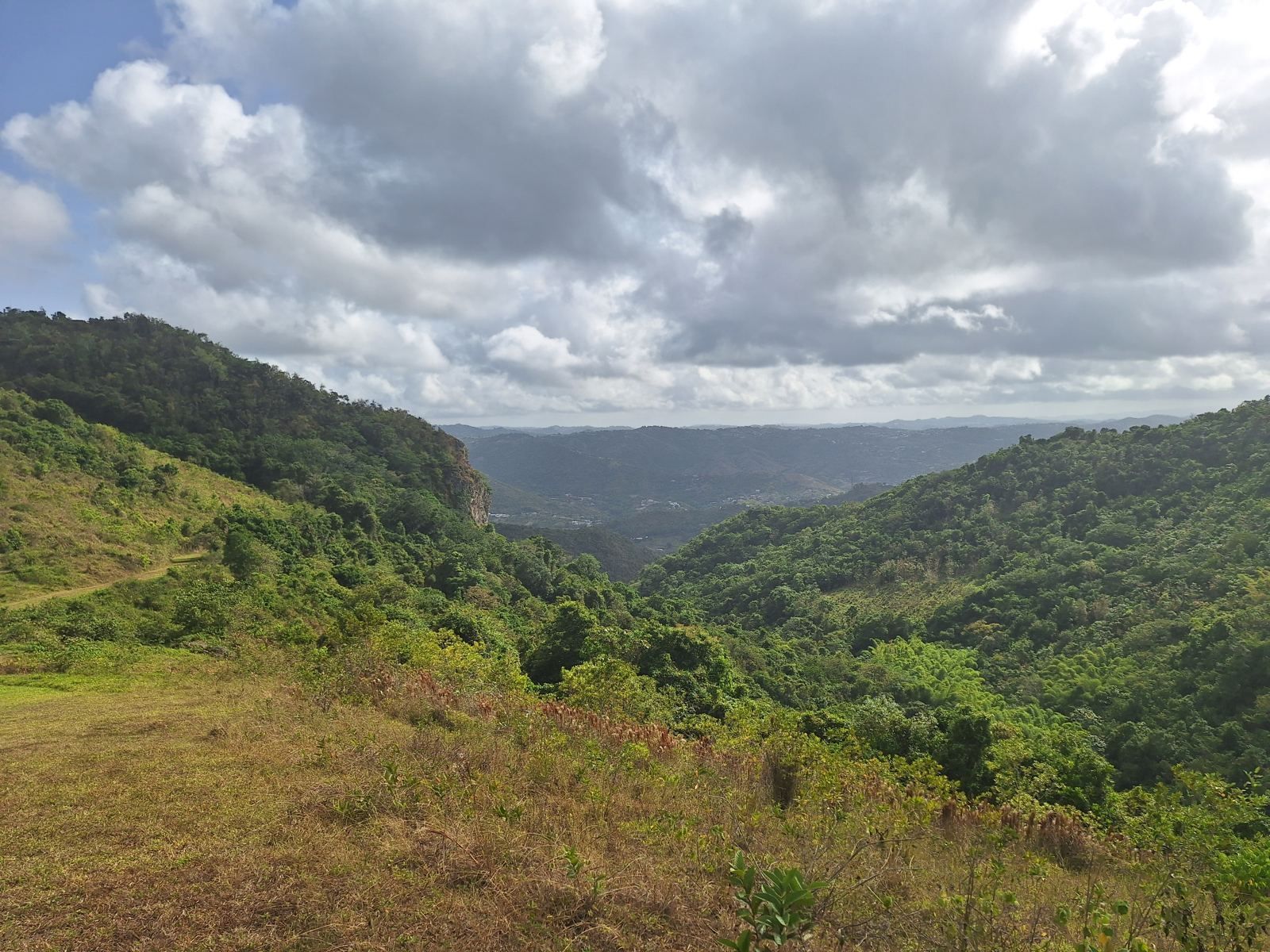
For a U.S. buyer, Puerto Rico's advantage is simple: it is part of the United States. There is no visa, the currency is the dollar, deeds are enforced in U.S.-supervised courts, and if you become a bona fide resident, Puerto Rico-source income can be excluded from federal tax, which neither Costa Rica nor the Dominican Republic can offer a U.S. citizen. Costa Rica wins on hurricane exposure and an established expat culture; the Dominican Republic wins on lower prices and very low property tax on modest homes. This guide compares the three side by side for someone looking at a farm, a finca or a mountain estate rather than a beach condo.
At a glance
| Puerto Rico | Costa Rica | Dominican Republic | |
|---|---|---|---|
| Visa or residency to live there | None for U.S. citizens | Needed for long stays | Needed for long stays |
| Currency | U.S. dollar | Colón (dollars widely used) | Peso (dollars widely used) |
| Foreign ownership of farmland | Same rules as any U.S. buyer | Allowed, except the coastal zone | Allowed on equal terms |
| Transfer tax at closing | Stamps and fees set by law | 1.5% plus fees | 3% |
| Annual property tax | Low (1950s assessed values) | 0.25% of fiscal value | 1% above about $182,000 |
| Federal tax relief for a U.S. citizen | PR-source income excluded for bona fide residents | No | No |
| Hurricane exposure | High | Low | High |
Who can own land
Puerto Rico. A mainland buyer buys exactly as a Puerto Rican would: any U.S. citizen, or a foreign national, can hold fee-simple title, including to large agricultural parcels. The only restrictions are land-use ones that apply to everyone, such as zoning and protected agricultural reserves. See how to buy land in Puerto Rico from the mainland.
Costa Rica. Foreigners can buy titled property with a passport and no residency or local partner. The main exception is the maritime zone: the first 200 meters inland from the high tide line belong to the state, the first 50 meters cannot be built on, and the next 150 meters are held under municipal concessions rather than owned, with limits on foreign majority control. Inland farms and mountain properties are generally outside this issue.
Dominican Republic. Foreigners can buy land, homes and commercial property on the same terms as Dominican citizens, individually or through a company, with no residency required. Remote purchases through a notarized power of attorney are common.
Residency and visas
Puerto Rico. None needed. A U.S. citizen can move tomorrow, work, vote in local elections and enroll children in school. The question in Puerto Rico is not immigration but tax residency, covered below.
Costa Rica. Long stays require a residency category, such as pensioner, rentista (fixed income) or investor. Law 9996 lowered the investor threshold from $200,000 to $150,000, but its incentives expired in July 2026 and, as of late 2026, whether the threshold reverted is disputed; Costa Rican attorneys recommend getting a written answer from immigration before committing funds. Investor residency generally requires the property to be in the applicant's own name.
Dominican Republic. Investment residency under Decree 631-11 requires at least $200,000 in real estate, which can be one property or several. Only unfinanced equity counts. Processing usually takes several months and involves a background check, medical exam and fingerprints.
Taxes for a U.S. citizen
This is where Puerto Rico separates from the others. The United States taxes its citizens on worldwide income wherever they live. In Costa Rica or the Dominican Republic you remain a U.S. taxpayer, and any foreign tax you pay is generally a credit against U.S. tax rather than a replacement for it. In Puerto Rico, a bona fide resident excludes Puerto Rico-source income from federal income tax under section 933 of the Internal Revenue Code, and an Act 60 Individual Resident Investor decree then sets the Puerto Rico rate on covered interest, dividends and post-move capital gains at 0 percent for applications filed by December 31, 2026, or 4 percent for applications filed after. See our Act 60 deadline guide and the bona fide residency checklist.
On property itself: the Dominican Republic taxes capital gains on real estate sold by individuals at a flat 10 percent under a law enacted in 2026, and Costa Rica taxes capital gains at 15 percent of the gain. Puerto Rico real estate held by a decree holder may qualify for Act 60 treatment on post-move appreciation. Each of these is fact-specific; get advice from a tax professional licensed in the country where you buy, and from your U.S. CPA.
Title, courts and closing
Puerto Rico uses a civil-law Property Registry, with deeds executed before a notary who is always a licensed attorney. U.S. title insurers write policies on the island, and disputes go to Puerto Rico courts with federal courts and the U.S. Supreme Court above them. See reading a Puerto Rico registry study.
Costa Rica has a public National Registry (Registro Nacional) where each property has a folio real showing owner, boundaries and liens. Total closing costs typically run about 3.5 to 5 percent of the price, including a 1.5 percent transfer tax, stamps and notary fees. Untitled "possession rights" properties carry real risk and need a court process to convert.
Dominican Republic uses a registered title certificate system. Buyers should confirm a clean title certificate, current property tax and a proper survey (deslinde) before paying a deposit. Closing costs usually run about 5 to 7 percent above the price, led by the 3 percent transfer tax, and registration in the new owner's name can take one to three months.
Holding costs: property tax and insurance
Puerto Rico's property tax is assessed by CRIM on values tied to the 1950s, so bills on rural land are modest. Costa Rica charges 0.25 percent of registered fiscal value each year, plus a separate luxury home tax on construction above roughly $318,000 in 2026. The Dominican Republic charges 1 percent a year only on assessed value above about $182,000, so modest homes pay nothing. Insurance is the hidden variable: windstorm coverage in hurricane-exposed Puerto Rico and the Dominican Republic costs more than in Costa Rica's interior. See property tax on farms in Puerto Rico.
Financing
All three are largely cash markets for large rural properties. Costa Rican banks lend mainly to legal residents, at lower loan-to-value ratios and higher rates. Dominican banks lend to non-residents, commonly at 50 to 70 percent of value with full income documentation. Puerto Rico banks lend to U.S. citizens under familiar rules but are cautious on large acreage, which is why owner financing and a lease with option to buy are common for estates. See owner financing in Puerto Rico and lease with option to buy.
Climate at elevation and hurricanes
All three have cool mountain districts. Costa Rica's Central Valley and the hills around it sit roughly 3,000 to 5,000 feet up, with famously mild weather. The Dominican Republic's highlands around Jarabacoa and Constanza are cooler still. Puerto Rico's Cordillera Central is lower, with Cayey and Aibonito between about 1,300 and 2,400 feet, but runs 10 to 20 degrees cooler than San Juan on the same afternoon.
On hurricanes, Costa Rica is the clear winner: it lies south of the usual Atlantic storm track and direct hits are rare. Puerto Rico and the Dominican Republic sit in the main hurricane belt. Mountain land in either avoids storm surge, but wind, heavy rain and long utility outages are real risks, which is why water storage, backup power and a solid house matter. See off-grid and self-sufficient properties.
Getting home
San Juan's Luis Muñoz Marín airport has frequent nonstop flights to East Coast cities and Florida, often under three to four hours to New York and around two and a half to Miami, and arriving from the mainland is a domestic flight with no passport control. Santo Domingo and Punta Cana have similar flight times to the East Coast; San José, Costa Rica is a bit farther from the Northeast. From a Cayey estate the airport is about an hour.
Where each one wins
- Choose Puerto Rico if you want U.S. law, U.S. currency, no immigration process and a real path to federal tax relief on local-source income, and you accept hurricane risk and higher prices than the Dominican Republic.
- Choose Costa Rica if avoiding hurricanes and joining a large English-speaking expat community matter more to you than taxes, and you are comfortable with a residency application.
- Choose the Dominican Republic if price per acre and low holding costs drive the decision and you are prepared for more due diligence on title.
If Puerto Rico fits, the estate this site describes is one example of what is available: about 100 acres (roughly 103 cuerdas) in two fee-simple parcels at 2,100 feet in Cayey, near Aibonito and about an hour from San Juan, with a remodeled three-bedroom main house, a second residence, two creeks, municipal water, a 550-foot well, a 12,000-gallon cistern, Starlink and a generator hookup, under A-G and B-Q zoning. It is offered at $2,375,000, reduced from $2,500,000, or on a $15,000 per month furnished lease or a lease with option to buy, with owner financing available. Property tax is about $990 a year and insurance about $2,799. See the main page or arrange a visit.
Frequently asked questions
Do U.S. citizens need a visa to live in Puerto Rico?
Which country has the lowest taxes for a U.S. citizen?
Can foreigners buy farmland in Costa Rica and the Dominican Republic?
Which has the least hurricane risk?
How do property taxes compare?
Can I get a mortgage for a farm in these places?
Sources and further reading
- Buying property in Costa Rica: what foreign buyers need to know, The Tico Times, September 2026.
- Property taxes in the Dominican Republic: what foreign owners actually pay, Century 21 Perdomo, August 2026.
- How to buy property in the Dominican Republic as a foreigner: complete 2026 guide, CLIC Inmobiliaria.
- Dominican Republic real estate residency route, BorderPilot.
- IRS practice unit: bona fide residency in U.S. territories, Internal Revenue Service.
- Informative Bulletin DDEC No. 2026-004, Puerto Rico Department of Economic Development and Commerce.
This comparison is general information, not legal, tax or immigration advice. Rules, thresholds and tax rates in all three jurisdictions change, and figures are as reported by the sources above in 2026. Confirm current requirements with an attorney and tax advisor licensed in the country where you plan to buy, and with your U.S. CPA. Information about the Cayey estate is provided by the owner and should be independently verified.